There was a time when many of us believed—truly believed—that America, while imperfect, was fundamentally trying to do the right thing. That our leaders, even when flawed, were restrained by a sense of duty, morality, and accountability. That Christianity, at its core, stood for kindness, humility, protection of the vulnerable, and a moral compass that pointed toward compassion rather than cruelty.
For many, that belief is now cracking.
This is not a sudden collapse. It is not hysteria. It is not the product of being “too online” or “too political.” It is the slow, painful realization that the institutions we trusted—government, media, religion—have been hollowed out and repurposed to serve power rather than people.
And if you feel disoriented, angry, heartbroken, or betrayed by that realization, you are not weak. You are awake.
The Grief No One Talks About
What many people are experiencing today is not a loss of patriotism or faith. It is grief.
Grief for the America we were taught to believe in. Grief for a Christianity that once emphasized love over dominance. Grief for the idea that truth mattered more than loyalty.
Grief is what happens when reality no longer matches the story we were told.
For decades, the narrative was simple: America may stumble, but it self-corrects. Christianity may be misused by some, but its moral foundation remains intact. Leaders may lie, but eventually accountability prevails.
What we are witnessing now feels different. The lies are no longer hidden. Corruption is no longer accidental. Cruelty is not a byproduct—it is a feature. And accountability has been replaced with tribal defense at all costs.
When Power Replaces Principle
Throughout history, power has always sought justification. Sometimes it wears a crown. Sometimes a uniform. Sometimes a flag. And very often, it wraps itself in religion.
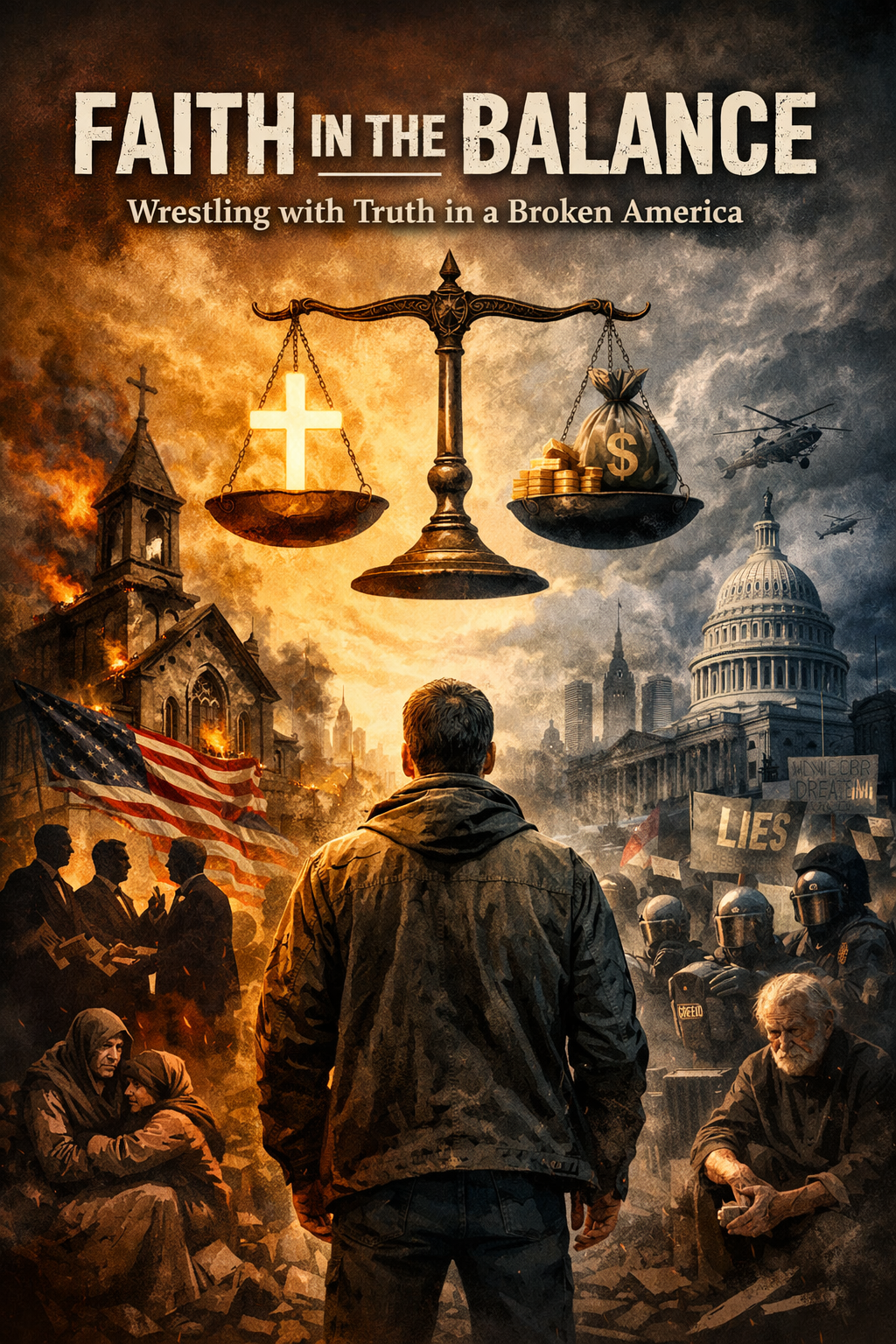
Modern Christianity in America—at least the version amplified by media and political operatives—often bears little resemblance to the teachings it claims to represent. The values once central to the faith have been inverted:
- Humility has been replaced by arrogance.
- Compassion has been replaced by contempt.
- Service has been replaced by entitlement.
- Truth has been replaced by convenience.
Faith has been reduced to a branding tool, a weaponized identity used to divide, intimidate, and control rather than heal and unite.
This is not a failure of belief. It is a hijacking of belief.
And history shows us this pattern again and again. Empires do not fear religion that demands obedience. They fear religion that demands moral accountability. So they reshape it. Dilute it. Commercialize it. Turn it into spectacle.
The Myth of the “Good Guys”
Perhaps the most painful realization is this: the idea that there were always clear “good guys” was a myth.
America has done extraordinary things—and horrific ones. Christian institutions have built hospitals, schools, and charities—and also enabled abuse, exploitation, and silence.
The difference now is not that corruption exists. The difference is that it is no longer ashamed.
When leaders openly lie without consequence, when propaganda replaces journalism, when cruelty is applauded as strength, and when morality is mocked as weakness, something fundamental breaks.
What breaks is trust.
Propaganda, Not Leadership
A functioning society requires shared reality. When truth becomes optional and loyalty becomes mandatory, democracy decays into performance.
Propaganda thrives not because people are stupid, but because fear, exhaustion, and identity are powerful tools. When people feel threatened, they cling to tribes. When they feel overwhelmed, they outsource thinking. When they feel lost, they follow whoever sounds confident—even if that confidence is built on lies.
This is how decent people are manipulated into defending indecency.
Heaven, Hell, and Moral Consequences
Some begin to question everything at this point—even faith itself. If institutions lied about power, did they also lie about heaven and hell? About God? About meaning?
That question is understandable.
But here is a grounded truth that requires no theology: actions have consequences.
Not always immediate. Not always cosmic. But always real.
Societies that reward dishonesty collapse from within. Communities that normalize cruelty become unsafe for everyone. Children raised on lies inherit trauma, not stability.
This is judgment without religion. This is consequence without myth.
The Quiet Strength of the Decent
Here is the part that rarely makes headlines: goodness still exists.
It exists in people who question rather than cheer. In those who refuse to dehumanize even when it would be easier. In those who walk away from corrupt systems rather than be consumed by them.
Decency is not loud. Integrity does not trend.
But it endures.
You do not need blind patriotism to love your country. You do not need institutional religion to live morally. You do not need certainty to act with conscience.
Sometimes the most honest stance is simply this:
“I don’t know what the ultimate truth is anymore—but I know injustice when I see it, and I refuse to be complicit.”
That is not weakness. That is moral courage.
A Reckoning, Not an Ending
This moment is not the end of faith, democracy, or goodness. It is a reckoning.
A reckoning that forces us to separate values from institutions. Truth from propaganda. Faith from power.
What emerges on the other side will not be comfortable. But it can be honest.
And honesty—real honesty—is where rebuilding begins.
To those who feel disillusioned, betrayed, or exhausted: you are not alone. You are not broken. You are responding rationally to a system that has lost its moral center.
The future will not be saved by loud voices or strongmen. It will be saved by people who quietly refuse to surrender their conscience.
And that, perhaps, is where hope still lives.
Written By Scott Randy Gerber for The Tipping Point Tampa Bay ©2026 All Rights Reserved