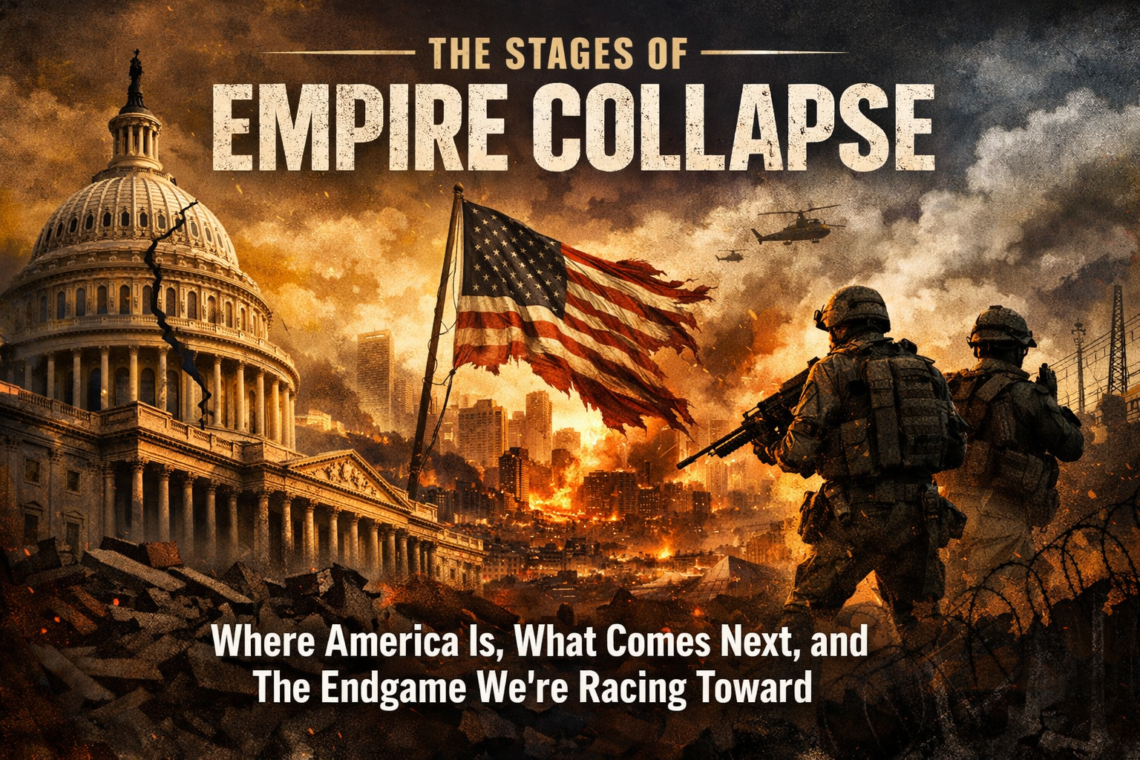
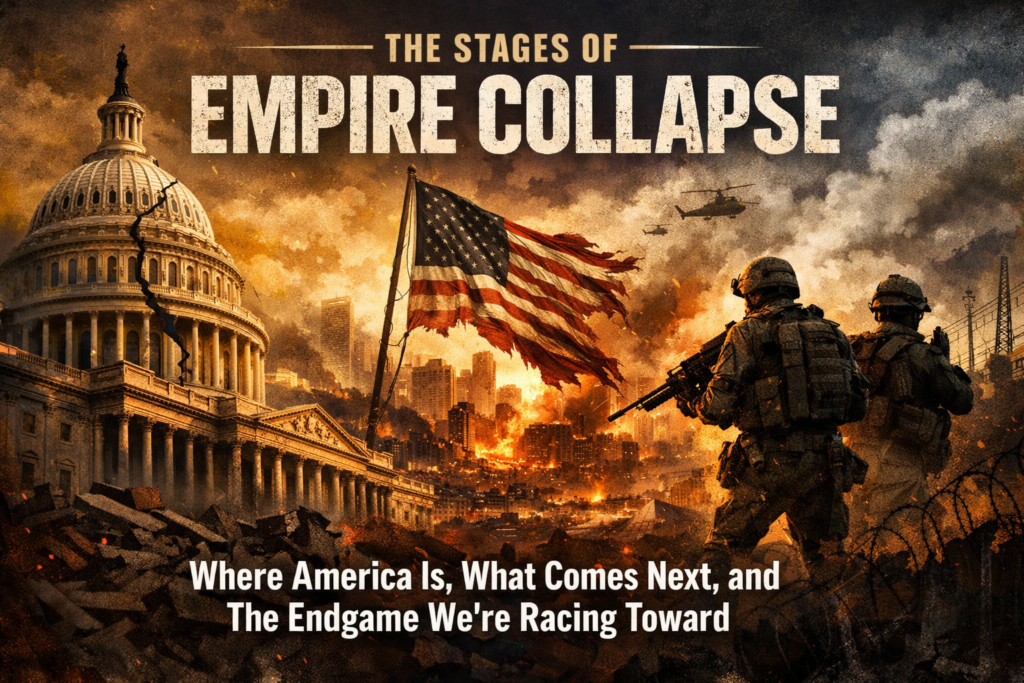
The Stages of Empire Collapse: Where America Is, What Comes Next, and the Endgame We’re Racing Toward
For generations, Americans were raised on a comforting belief:
that the United States was different — immune to the fate of past empires.
History disagrees.
Empires do not collapse because they are evil.
They collapse because they stop correcting themselves.
The United States is not “falling” in the dramatic, Hollywood sense. There are no tanks in the streets or foreign flags flying over Washington. But history rarely ends that way. Instead, it erodes — slowly, quietly, and then all at once.
What we are witnessing today is not a sudden breakdown.
It is late-stage decline — a familiar phase in a very old story.
The Predictable Life Cycle of Empires
Across civilizations — Rome, Britain, Spain, the Soviet Union — the pattern is remarkably consistent. Different cultures, different eras, same arc.
Stage 1: Expansion and Unity
This is the idealistic beginning.
- Shared purpose
- Functional institutions
- High public trust
- Sacrifice for the common good
America lived here during its founding and early growth, when institutions mattered more than personalities.
Stage 2: Peak Power
This is the apex.
- Military dominance
- Economic leadership
- Cultural influence
- Global credibility
For the United States, this period stretched from World War II through the end of the Cold War. America rebuilt Europe, shaped global institutions, and defined the post-war world order.
This was our high-water mark.
Stage 3: Overextension
Every empire eventually mistakes power for permanence.
- Endless wars
- Exploding debt
- Financialization replaces production
- Infrastructure decays
- Elites grow disconnected from the public
Vietnam, Iraq, Afghanistan — conflicts that drained legitimacy rather than securing it. At home, debt replaced growth and speculation replaced value creation.
This stage always feels survivable — until it isn’t.
Where We Are Now: Institutional Decay
Stage 4: Institutional Breakdown
This is where decline becomes visible.
Institutions still exist, but their credibility erodes:
- Laws are applied selectively
- Accountability disappears for elites
- Corruption is normalized
- Media becomes tribal and ideological
- Expertise is dismissed
- Objective truth becomes contested
The system keeps functioning — but no longer for the people it was designed to serve.
This is not collapse.
It is rot.
The Most Dangerous Phase: The Legitimacy Crisis
Stage 5: Loss of Trust
This is the stage America has clearly entered.
A legitimacy crisis occurs when:
- Citizens no longer believe institutions represent them
- Elections are distrusted
- Courts are viewed as political
- Law enforcement is seen as partisan
- Media credibility collapses
The left believes the system is rigged by capital.
The right believes it’s rigged by elites and bureaucracy.
They disagree on the cause — but they agree on the outcome:
The system no longer works.
Once legitimacy is lost, societies no longer operate on consent.
They begin operating on force.
What Comes Next: The Crisis Trigger
Collapse does not happen gradually.
It happens after a trigger.
Historically, those triggers include:
- A major economic or currency crisis
- A widely rejected election
- Large-scale internal unrest
- Military or law-enforcement fragmentation
- A shock that overwhelms weakened institutions
America has already absorbed multiple shocks — 9/11, the 2008 financial crisis, COVID — but each one drained institutional trust further.
The danger is not the next crisis itself.
The danger is how little credibility remains to manage it.
The Endgame: How This Usually Ends
Once an empire reaches this point, history shows only three realistic outcomes.
1. Fragmentation
- Power shifts to states, regions, or economic blocs
- Federal authority weakens
- Unity exists mostly in name
This does not always mean formal breakup. More often, it looks like uneven enforcement of national authority and quiet decentralization.
2. Authoritarian Consolidation
This is the most common response — and the most tempting.
- “Order” replaces liberty
- Emergency powers become permanent
- Surveillance expands
- Dissent is reframed as instability
This path often begins with public support.
It rarely ends with freedom.
3. Renewal (Rare, but Possible)
True renewal requires:
- Elite accountability
- Restoration of the rule of law
- Economic restructuring
- Institutional reform
- A shared national narrative grounded in reality
This is the hardest path — because it demands sacrifice from those who benefit most from the current system.
Very few empires choose it.
What to Expect in the Near Future
Regardless of the path taken, certain trends are likely:
- Increased political volatility
- Expanded use of state power
- Economic instability and wealth concentration
- Information warfare replacing shared reality
- Declining global influence, even if military power remains
Empires don’t usually fall with explosions.
They fall with exhaustion.
The Tipping Point
America’s greatest threat is not foreign enemies.
It is internal decay combined with moral arrogance — the belief that history applies to everyone else.
We are not doomed.
But denial is no longer an option.
History does not ask whether a nation means well.
It asks whether it can correct itself before force becomes the only language left.
That is the tipping point.
Written by Scott Randy Gerber for The Tipping Point Tampa Bay ©2026 All Rights Reserved