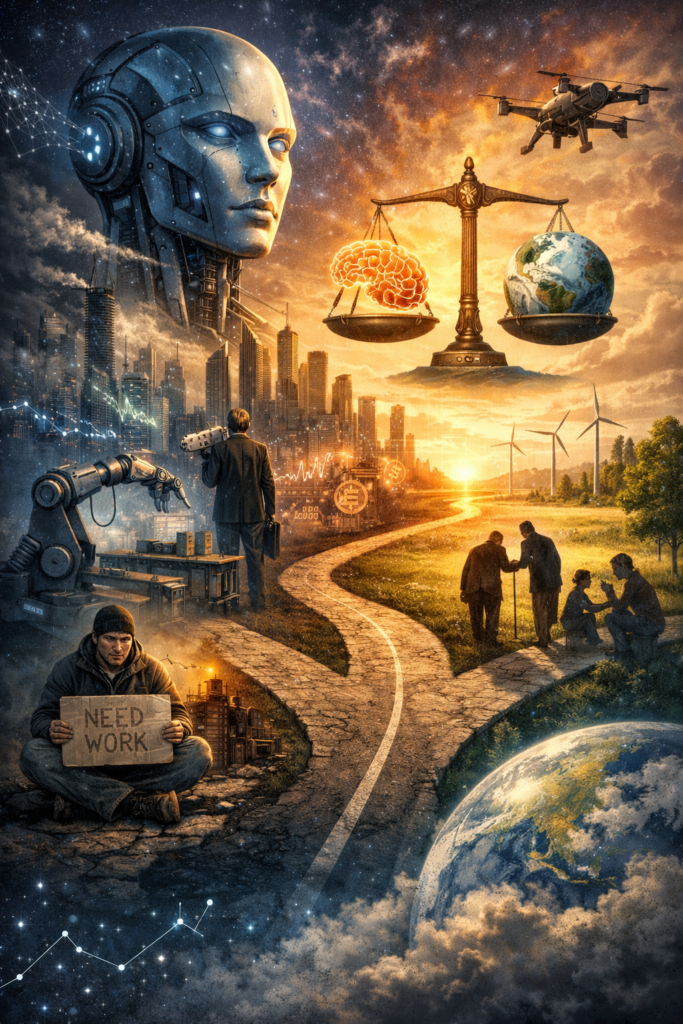
Artificial Intelligence and the Human Crossroads
Power, Responsibility, and the Choices That Will Define Our Future
Artificial Intelligence has moved from theory to reality at unprecedented speed. In just a few years, AI has reshaped how we work, communicate, create, and govern—leaving institutions, labor markets, and ethical frameworks struggling to keep pace.
This moment is not simply a technological shift.
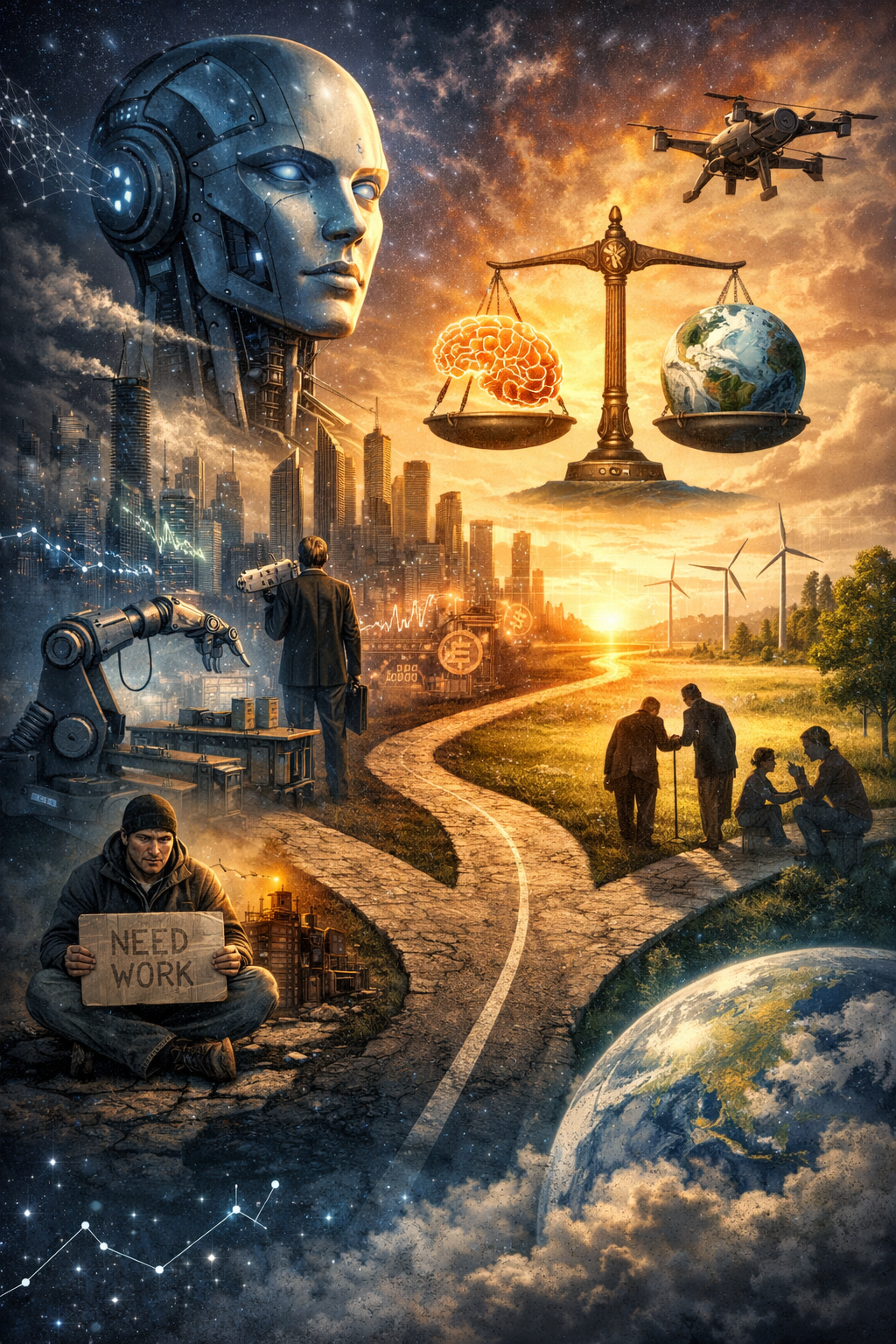
It is a civilizational crossroads.
AI is neither inherently good nor evil. It is a tool—arguably the most powerful tool humanity has ever created. The consequences of its rise will depend not on what AI can do, but on how it is deployed, who controls it, and whether moral responsibility keeps pace with innovation.
What Artificial Intelligence Is—and Is Not
AI systems do not possess consciousness, intent, or moral judgment. They analyze data, recognize patterns, and generate predictions at scale—but they do not understand meaning or ethics.
The real risk is not that AI will replace humanity.
The real risk is that AI will accelerate systems already shaped by inequality, short-term profit, and unchecked power.
History offers a clear warning: when technology advances faster than ethical governance, harm follows.
Why AI Feels Different Than Past Revolutions
Previous industrial revolutions replaced physical labor.
AI replaces cognitive labor.
For the first time, machines can:
- Write and analyze complex information
- Perform financial and market analysis
- Diagnose medical conditions
- Generate art, music, and design
- Automate decision-making at scale
This directly challenges how modern societies define human value—through employment, productivity, and economic output. The result is widespread anxiety, declining trust, and political instability.
This concern is not irrational. It is structural.
Who Is Driving AI’s Expansion
There is no single global authority controlling AI. Instead, its development is shaped by overlapping interests:
- Governments seeking efficiency, security, and influence
- Corporations pursuing profit, automation, and market dominance
- Militaries racing for strategic advantage
- Financial systems prioritizing speed and scale
These forces are not coordinated by a master plan—but they are united by short-term incentives. Long-term human well-being is often an afterthought.
Employment, Automation, and the Middle Class
AI-driven automation is already reshaping employment—especially white-collar, administrative, and repetitive knowledge-based jobs.
Roles most at risk include:
- Clerical and administrative work
- Entry-level professional roles
- Basic content creation and analysis
- Routine financial and operational tasks
Roles likely to endure:
- Work requiring trust, accountability, and ethics
- Care, leadership, and human-centered services
- Skilled physical labor in unpredictable environments
- Creative work grounded in lived experience
The uncomfortable truth is that new jobs may not replace lost jobs one-for-one. Societies must rethink education, income stability, and human dignity in a world where traditional employment is no longer guaranteed.
The Greatest Risk: Disconnection, Not Extinction
AI’s most serious threat is not human extinction—it is human marginalization.
Unchecked, AI could deepen:
- Economic inequality
- Centralization of power
- Surveillance justified as efficiency
- A loss of purpose for millions
History shows that when people feel unnecessary or invisible, social cohesion collapses.
No algorithm can solve that.
What Must Happen Now
To navigate this transition responsibly, societies must focus on four priorities:
- Redefining Human Value
Human worth must not be tied solely to productivity or economic output. - Establishing Ethical Guardrails
Transparency, accountability, and limits on surveillance must be enforced—nationally and globally. - Human–AI Collaboration, Not Competition
AI should augment human judgment, not replace responsibility. - Rebuilding Trust and Community
Technology cannot replace human connection, empathy, and shared purpose.
A Choice Still Within Reach
AI does not determine humanity’s future.
Our decisions do.
This moment will define whether technology serves people—or whether people are reshaped to serve systems.
The future is not written in code.
It is written in values, policy, and courage.
We are standing at the tipping point.
Written by Scott Randy Gerber for The Tipping Point Tampa Bay ©2026 All Rights Reserved