
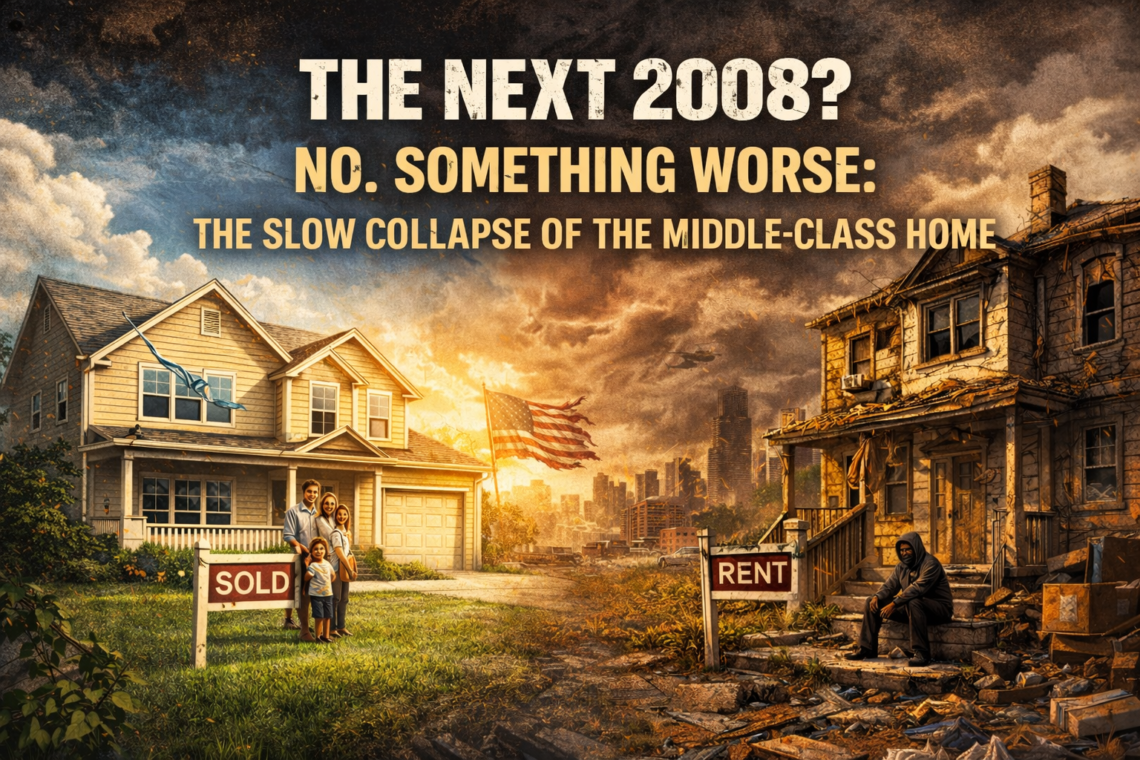
The Next 2008? No. Something Worse: The Slow Collapse of the Middle-Class Home
People keep asking the wrong question.
They want to know:
“Is another 2008 coming?”
The honest answer is no.
What’s forming now isn’t a repeat of 2008 — and that’s exactly why it may be worse.
2008 was violent, sudden, and visible. It shocked the system, forced accountability (at least briefly), and reset housing prices in a way that eventually allowed a new generation to buy back in.
What we are heading toward now doesn’t reset.
It locks people out permanently.
2008 Was a Financial Heart Attack
What’s coming is a chronic disease.
The 2008 housing crash happened because the system was built on fraud:
- toxic mortgages
- reckless leverage
- adjustable-rate time bombs
- rating agency corruption
- banks gambling with other people’s lives
When it failed, it failed fast.
That collapse hurt millions — but it also cleared the market. Prices fell hard. Ownership eventually became possible again for those who survived the fallout.
That’s not what’s happening now.
This Crisis Is Structural, Not Accidental
Today’s housing problem isn’t driven by bad loans.
It’s driven by bad math.
- Home prices far outpaced wages
- Mortgage rates reset higher and stayed there
- Insurance and property taxes exploded
- Construction failed to keep up with population growth
- Speculation replaced shelter as the primary function of housing
Nothing here is “broken” in the traditional sense.
It’s working exactly as designed — just not for regular people.
Why This Can Be Worse Than 2008
1. There Is No Reset Button
In 2008, prices collapsed.
In this cycle, prices may stagnate or drift down — but not enough to restore affordability. Even a 10–15% decline doesn’t fix a market that’s already 40–60% out of reach for the middle class.
That means millions stay locked out indefinitely.
2. The Middle Class Has No Cushion Left
Before 2008:
- household debt was lower
- healthcare costs were lower
- rent was lower
- credit was easier
- savings went further
Today, the middle class is already leveraged, exhausted, and living paycheck to paycheck.
There is no margin for error.
One layoff.
One medical issue.
One spike in insurance or rent.
That’s not resilience.
That’s fragility.
3. Renting Is No Longer a Temporary Phase
Renting used to be transitional.
Now it’s becoming permanent.
When:
- rents rise faster than wages
- down payments become unreachable
- credit standards tighten
- investors outbid families
People don’t “wait it out.”
They age out of ownership entirely.
That’s how a middle class disappears without a single dramatic event.
The Ownership Divide Is Hardening
This isn’t just about housing prices.
It’s about who gets to build wealth.
Homeownership has historically been the primary way American families accumulated:
- equity
- stability
- retirement security
- intergenerational opportunity
When ownership becomes restricted to a shrinking group, the country doesn’t just become unequal — it becomes stratified.
Two Americas emerge:
- those who own assets
- those who serve asset owners
That’s not a market correction.
That’s a class transformation.
Why Investors Win Even in a Downturn
Here’s the brutal reality most people miss:
If housing weakens, capital doesn’t disappear.
It waits.
When prices soften:
- institutional buyers step in
- private equity looks for discounts
- rental portfolios expand
- homes turn into yield-generating instruments
Families struggling with higher rates and job insecurity don’t get the “opportunity.”
They get displaced.
This is how downturns consolidate power upward.
The Real Trigger Won’t Be Housing — It Will Be Jobs
Housing almost never collapses on its own.
It collapses after employment breaks.
If job losses accelerate:
- delinquencies rise
- forced selling increases
- foreclosures follow
- prices finally fall
But by then, the buyers waiting on the sidelines won’t be middle-class families.
They’ll be firms with cash, algorithms, and patience.
That’s why the recovery looks nothing like the past.
What “Something Worse” Actually Looks Like
Something worse than 2008 doesn’t mean more chaos.
It means less opportunity.
It looks like:
- permanent renter households
- delayed or abandoned family formation
- rising multi-generational housing out of necessity
- declining birth rates
- geographic immobility
- normalized financial anxiety
It looks quiet.
And that’s why it’s dangerous.
Why This Becomes a Political and Social Crisis
Housing instability doesn’t stay in the housing market.
It spreads:
- into health outcomes
- into education access
- into crime rates
- into political extremism
- into social unrest
People who feel locked out stop believing the system works for them.
And when enough people reach that conclusion, legitimacy collapses.
That’s when societies fracture.
This Is the Tipping Point
The question isn’t whether housing prices go up or down next year.
The real question is this:
Does America still believe the middle class deserves ownership — or only survival?
Because once a society quietly accepts that most people will never own anything meaningful, it has crossed a line it doesn’t easily come back from.
No crash headline.
No dramatic reset.
Just a slow realization that the American Dream didn’t fail…
It was replaced.
Written by Scott Randy Gerber for The Tipping Point Tampa Bay ©2026 All Rights Reserved.


